Report · Alberta
Alberta uses Sovereignty Act to challenge federal hate law
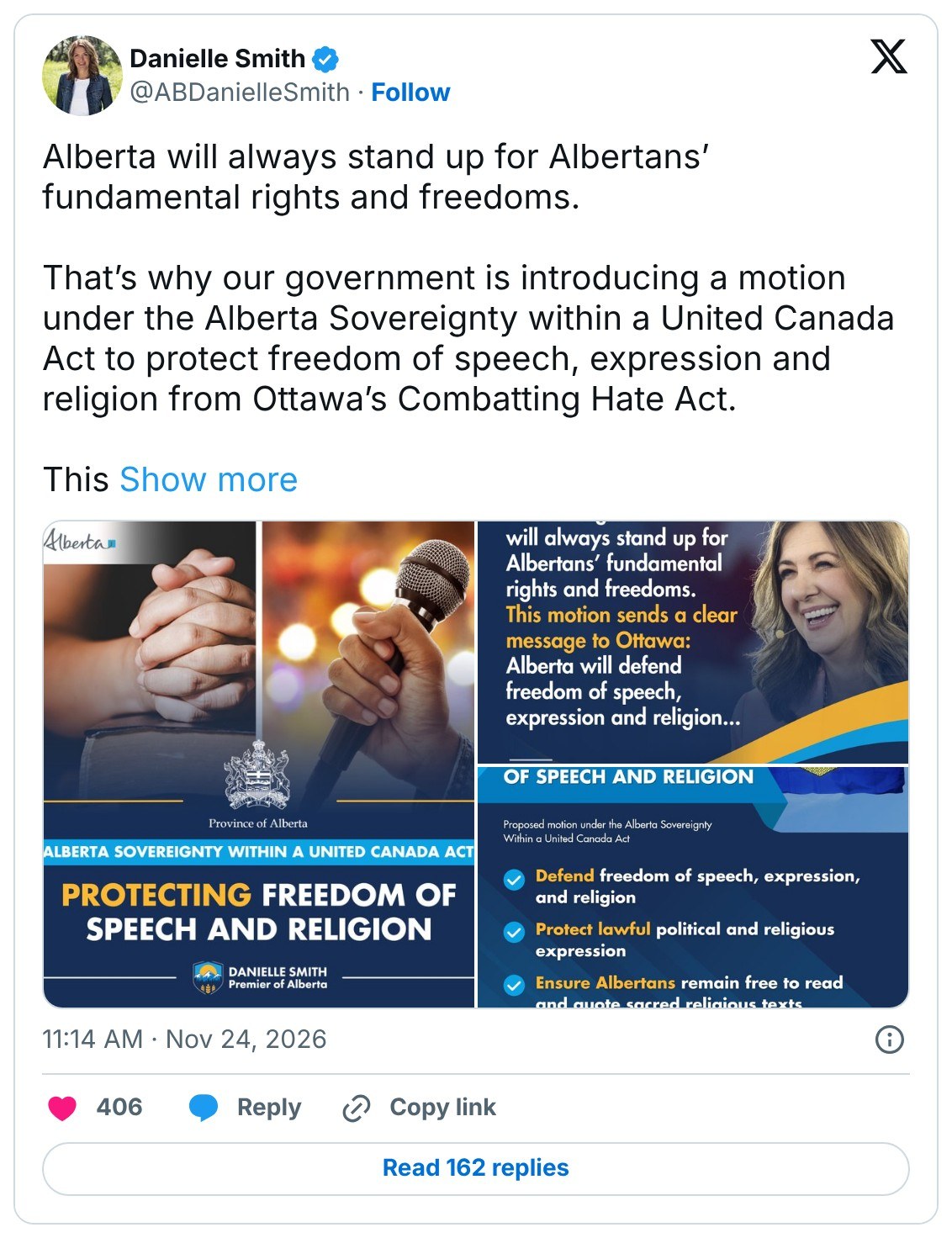
Premier Danielle Smith says a new Alberta Sovereignty Act motion protects religious expression from Ottawa's Combatting Hate Act, while Ottawa and critics dispute the need.

Key points
- Premier Danielle Smith announced on Tuesday, Nov. 24, a motion under the Alberta Sovereignty Act aimed at the federal Combatting Hate Act, which repealed a religious opinion defence in hate propaganda law.
- Ottawa says the repeal does not criminalize good-faith religious expression, and that Alberta's justice minister already controls whether such charges proceed.
- NDP Leader Naheed Nenshi calls the motion political, and a Calgary law professor says it adds little legally.
The facts
EDMONTON Premier Danielle Smith announced on Tuesday that Alberta will bring a motion under the Alberta Sovereignty Act against the federal Combatting Hate Act, also known as Bill C-9, according to CBC News. The law came into force in July and removed a Criminal Code defence for people who, in good faith, expressed an opinion on a religious subject or one based on a religious text.
The province says the repeal could discourage people from speaking openly about their faith. The province said in a news release that, if passed, the motion would ask cabinet to look at lawful ways to shield Albertans from the federal law. The government did not name specific measures cabinet would take, CP24 reported.
"This motion protects lawful political and religious expression, and it would ensure Albertans remain free to read and quote sacred religious texts without fear of prosecution," Smith said at a news conference.
Justice Minister Mickey Amery said the repeal could lead Albertans to be unsure when they can express their beliefs. "That uncertainty can have a chilling effect on freedom of expression," he told reporters, according to CTV News Edmonton. He added that free expression does not extend to violence, threats or criminal hatred.
Asked whether any religious leader had been prosecuted since the law took effect, Amery did not give an example. He said the government wants to be proactive. He had no figures from after the federal law took effect, the Edmonton Journal reported. For 2025-26, he put the number of hate crime cases at 14.
The federal side disputes the premise. A Department of Justice Canada page says the repeal does not criminalize religious expression, which the Charter protects. It says good-faith preaching and scripture readings would not meet the standard for the offences.
Spokesperson Joannie Fogue, for federal Justice Minister Sean Fraser, said Ottawa agrees Canadians should be free to practise their faith. Fraser's office also said any charges would need Amery's consent, the Edmonton Journal reported.
Who is affected
The motion addresses people of all faiths in Alberta, including clergy and worshippers. Smith cited pastors, rabbis and imams as examples of people who, she said, should not be monitored or arrested for their sermons.
Hate crime victims and the groups supporting them are also part of the discussion. Nina Saini, director of Stop Hate AB, told CTV News Edmonton she supports free speech but is concerned about any move to make prosecution of hate propaganda and the wilful promotion of hatred a lower priority.
Rabbi Ari Drelich of Chabad Lubavitch in Edmonton told CBC News he supports the federal law's overall goal but said a balance is necessary.
What it means
The Alberta Sovereignty Act, passed in 2022, lets the province push back on federal laws that the legislature considers unconstitutional or harmful to Albertans' rights. CP24 reported that this is the fourth motion under the act. Earlier motions took on federal electricity rules, an emissions cap on oil and gas, and the firearms program.
Smith said the province would not wait for a case to arise. "We just don’t want to wait until somebody's pastor has been hauled off to jail," she said. Nenshi disagreed with that framing and linked the timing to the governing party's annual meeting in Calgary, which starts Friday.
"They need to throw some red meat to the base," Nenshi said. Smith denied the motion was aimed at party members, the Edmonton Journal reported.
Legal experts cited in the coverage say there are limits. University of Alberta law professor Gerard Kennedy told CBC News he expects the motion to guide police and prosecutors, since an order would go too far. He said the province can choose not to enforce a federal law it does not consider a priority, but Ottawa could then enforce it.
University of Calgary law professor Shaun Fluker told CTV News Edmonton, "These motions just tend to be more political acts of theatre than really anything of legal substance."
What happens next
The Edmonton Journal reported that the motion could reach the legislature as early as Tuesday evening. The sources do not specify when a debate or vote will take place.
Under the act, MLAs debate a motion, which passes with majority support. Cabinet then reviews any proposed actions to ensure they are legal and constitutional, CTV News Edmonton reported. Separately, Onion Lake Cree Nation has challenged the act in court, and Alberta has asked the court to dismiss the challenge.
Sources
- CBC News: Alberta plans Sovereignty Act motion on federal hate legislation
- CP24: Alberta invokes Sovereignty Act over federal hate crime law, citing religious freedom concerns
- CTV News Edmonton: Smith moves to assert freedom of speech and religion in new stand against federal law
- Edmonton Journal: Alberta government to use Sovereignty Act against federal hate speech law
- Department of Justice Canada: Combatting Hate Act (Bill C-9)
Fact-check. This story was written from 9 verified sources (8 independent reports); 8 factual claims checked against outside sources, none contradicted. Published Nov. 24, 2026, 6:20 p.m. PT.
Spotted an error? Write to [email protected]. Read our corrections policy.
Know something we should report in your community? Send a tip to [email protected].